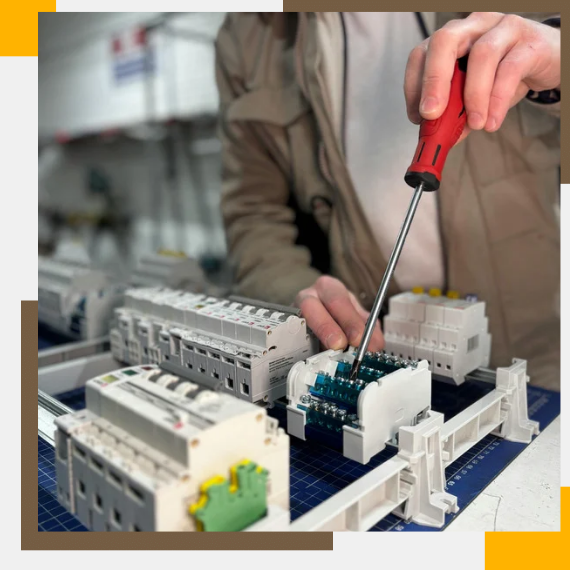
Electrical Design

Delivering electrical systems design for clarity, safety, efficiency, and long-term reliability, to support the way buildings are planned, constructed, and used

Electrical Designs Built Around How People Interact with Buildings

Lighting affects how people experience a space. Panel locations determine maintenance workflows. Distribution choices influence equipment reliability under load. For architects, the challenge isn't just meeting code, it's planning electrical systems that support the building's purpose without disrupting the design.
At National MEP Engineers, we approach electrical design by understanding how spaces function once they are occupied. Our engineers evaluate equipment diversity, load profiles, lighting needs, egress routes, safety systems, and future scalability before finalizing documentation. This creates documentation that is straightforward for contractors, predictable for owners, and supportive of the architectural goals set from day one.


Electrical Engineering Grounded in Practical Constraints and Code Logic

Electrical systems require a balance of technical rigor and practical decision-making. A building’s electrical design must deliver uninterrupted service, satisfy NEC requirements, and remain accessible for maintenance while minimizing operational risks. We plan for these realities by carefully analyzing power-distribution paths, short-circuit ratings, equipment characteristics, grounding requirements, lighting strategies, and fault protection. Rather than retrofitting code compliance into completed layouts, we integrate safety requirements from the start. Panel configurations, feeder routing, and equipment placement are developed with clarity and constructability in mind, reducing the likelihood of field conflicts, AHJ comments, and redesign during construction.

Proactive Power Distribution Planning to Avoid Downstream Issues

Many electrical challenges originate upstream, long before CD production. If mechanical and electrical rooms compete for space, or riser locations shift late in the design, the entire distribution strategy can fail due to coordination conflicts. Our role is to prevent these situations from developing. During SD and DD, we map out the loads, branch circuits, panel groups, transformer locations, and emergency systems that will support the project. Early planning allows us to set realistic spatial demands for electrical infrastructure and coordinate these needs with architectural, structural, and mechanical requirements. By the time the project reaches CD, the electrical system fits the building, not the other way around.

Tools That Support Better Decisions, Better Drawings

Practical electrical engineering requires both rigorous analysis and clear representation. To support accurate decision-making, we use fault-current evaluation tools, lighting simulation software, and load-balancing methodologies to validate system performance before construction begins. These tools help us anticipate voltage-drop issues, feeder-sizing concerns, and the need for protection coordination early in the process. Once the engineering is validated, we translate the design into precise drawings using BIM and CAD platforms. By prioritizing analysis before documentation, we deliver electrical designs that contractors can trust, and AHJs can review with minimal back-and-forth.

Tailored Electrical Solutions for Building Type, Operating Patterns, and Future Needs

Different buildings call for different electrical approaches. A restaurant demands high-diversity equipment planning. A multifamily building requires organized metering and life-safety coordination. Commercial offices often benefit from flexible lighting and easily maintainable panel arrangements. We study the building’s intended use, equipment profile, circulation patterns, and energy expectations to define a distribution strategy that integrates naturally with the space.
Our key electrical deliverables include:
Different buildings call for different electrical approaches. A restaurant demands high-diversity equipment planning. A multifamily building requires organized metering and life-safety coordination. Commercial offices often benefit from flexible lighting and easily maintainable panel arrangements. We study the building’s intended use, equipment profile, circulation patterns, and energy expectations to define a distribution strategy that integrates naturally with the space.

Why Architecture Firms Choose Our Electrical Engineering Team

Architectural teams work with us because our electrical designs adapt to real-site conditions and real project pressures. We communicate clearly, respond quickly, and offer design pathways that reflect the complexity of modern construction.
What sets our electrical engineering apart:
Our value doesn’t come from drafting electrical drawings. It comes from anticipating problems that can derail schedules, uncovering conflicts before contractors do, and ensuring every part of the system aligns with code, coordination, and architectural priorities.

Balancing First Costs, Energy Use, and Operational Flexibility

Electrical system decisions ripple through a building’s entire lifecycle. The panel configuration chosen in SD affects tenant fit-out costs years later. Lighting selections made in DD determine energy consumption for decades. Emergency system architecture influences insurance premiums and evacuation planning.
We help architects and owners evaluate these trade-offs during the design phase, when changes are still possible. Our engineers model different distribution approaches, assess energy-code pathways, and identify where increased upfront investment creates long-term savings. This perspective ensures electrical systems support both immediate construction goals and future operational needs.

Get Your Free Consultation Today!

Do you have questions or need expert advice? Contact us now, and let our team assist you with your MEP engineering needs!


    FAQs

    We evaluate equipment loads, routing paths, code-required clearances, and operational needs to identify locations that are safe, accessible, and compatible with the architectural layout, avoiding late-stage relocations that disrupt coordination.
    Yes. We routinely assess legacy infrastructure by reviewing available plans, performing site audits (as needed), and validating utility capacity. This approach allows us to design upgrades that integrate safely with existing systems.
    We coordinate with utility providers to confirm service capacity, transformer locations, and interconnection requirements before finalizing designs. During AHJ review, we respond promptly to comments and provide code references, load calculations, and clarifications that satisfy local requirements. Our PE-led approach ensures accurate interpretations aligned with NEC and jurisdictional amendments.
    We develop lighting layouts, control zoning, and fixture coordination. When required, we also provide photometric evaluations to verify illumination levels in critical areas such as offices, corridors, and exterior pathways.
    We coordinate in BIM to align conduit routes, equipment connections, and electrical clearances with mechanical ductwork, piping, and architectural elements. This reduces clashes and simplifies field installation.
    Yes. We consider load diversity, spare capacity, and panel allocation strategies that allow additional circuits or equipment without major system reconfiguration.