
Fire protection design plays a vital role in building coordination, permitting, and life safety performance. National MEP Engineers develops NFPA-adherent fire suppression, detection, standpipe, fire pump, and fire alarm systems that maintain AHJ requirements and architectural intent. By prioritizing early coordination and constructability-driven planning, we minimize redesign, simplify permitting, and yield integrated fire protection solutions for modern buildings.
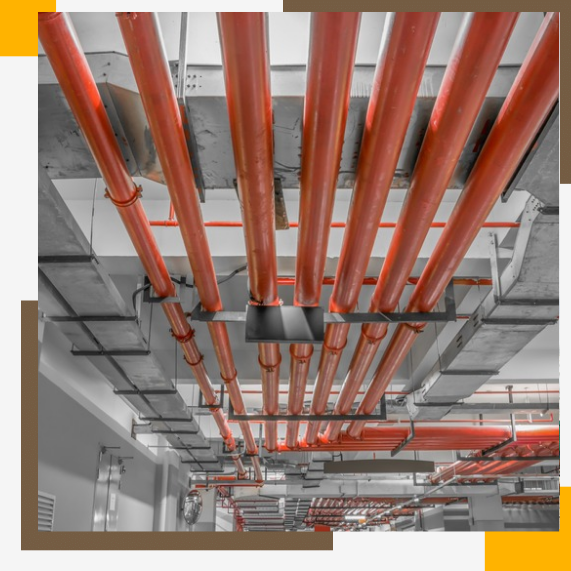
Effective fire protection planning starts with NFPA and IBC compliance analysis, egress evaluation, occupancy classification, and fire-resistance assessment. Our engineers validate fire flow demands, water supply, system zoning, and vertical distribution requirements to determine ideal suppression strategies, fire pumps, and standpipe systems. This unique approach ensures coordinated, code-compliant designs that curtail redesign and support architectural intent.


Fire protection systems’ integration within complex architectural and building constraints is a must. Using Revit and AutoCAD, our team coordinates suppression and alarm systems with mechanical, structural, and architectural components. It helps identify conflicts associated with ductwork, lighting layouts, standpipes, and egress pathways early. This BIM-driven approach successfully reduces on-site modifications, preserves ceiling aesthetics, and supports constructable, code-compliant fire protection design.
We support a wide range of commercial, residential, institutional, and industrial facilities with tailored fire protection solutions.
Our core fire protection engineering design capabilities:


Our fire protection engineering approach merges the strength of code expertise, BIM coordination, hydraulic analysis, and constructability planning to facilitate efficient permitting, installation, and life safety compliance.
Core features making our fire protection engineering reliable:
This niche approach helps architects maintain project schedules, attain full code compliance, and deliver life-safe buildings while preserving the original design intent.

Rated corridors and ceilings require careful treatment of sprinkler escutcheons, head types, and penetration details. We help define placement that preserves ratings, meets NFPA spacing rules, and avoids introducing unplanned additional rated assemblies.
Hazard classification, ceiling geometry, beam depths, and obstructions govern sprinkler spacing and location. We coordinate in BIM so lighting grids, diffusers, access panels, and sprinkler heads coexist without compromising appearance or code requirements. This prevents late-stage ceiling redesigns.
We classify hazard levels using NFPA 13 criteria, review storage height and density, and analyze equipment or room function. This ensures that each space, such as offices, kitchens, electrical rooms, or storage areas, is appropriately protected.
Yes. We specialize in renovations where existing infrastructure may be limited. We assess available water supply, verify existing pipe sizes, and adjust head layout and spacing to satisfy current code while minimizing disruption.
Shaft planning should begin during schematic design because fire risers, standpipes, and pump discharge piping often compete with other services for vertical space. We identify required shaft dimensions early so structural and architectural layouts don’t need major revisions later.
Fire protection codes are interpreted differently across jurisdictions. We assist by reviewing the local AHJ’s expectations, preparing documentation that justifies design assumptions, and adjusting system layouts or calculations proactively to accelerate plan approval.
Till now, National MEP Engineers has successfully completed fire protection and life safety design projects in North Carolina, South Carolina, New Jersey, Maryland, Pennsylvania, Tennessee, Washington, Florida, Alabama, Mississippi, Michigan, Ohio, Virginia, California, Oregon, and Texas.
Copyright © 2026 natlmep.com. | All rights reserved
Our website uses third-party cookies to enhance user experience and analyze site performance. By continuing to use this site, you consent to our use of cookies as described in our Privacy Policy .
Unlock Our Technical Capabilities

|
Thank you for Signing Up |

|
Thank you for Signing Up |

