
Fire Protection Engineering & Life Safety Design

Integrated fire protection systems engineered for compliance, constructability, and dependable building safety

Fire Protection That Safeguards People, Preserves Property, and Supports Architectural Intent

Fire protection design affects ceiling layouts, equipment room sizing, egress pathways, water supply needs, and the overall coordination of building systems. When fire protection strategies are unclear, architects face delays, costly redesigns, and stalled permitting.
National MEP Engineers helps architectural teams avoid those risks. Our fire protection engineers design suppression, detection, and life safety systems that meet NFPA standards, align with local AHJ requirements, and integrate smoothly into the architectural framework. Whether the project requires a conventional wet system, dry or pre-action protection, standpipes, fire pumps, or a combined fire alarm system, our work is guided by engineers who understand how life safety requirements intersect with construction realities.
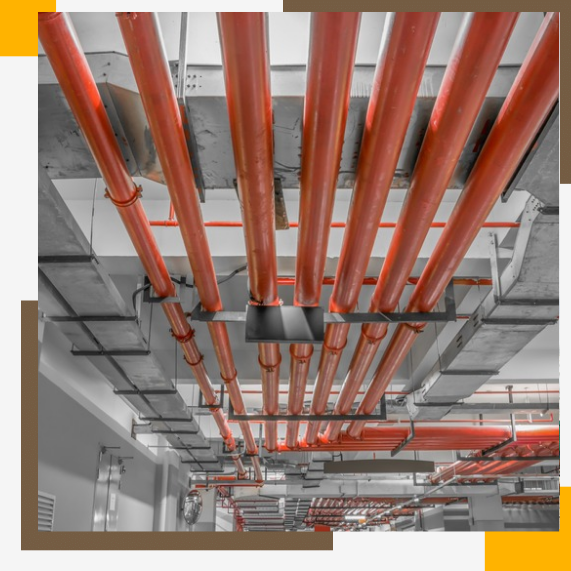

NFPA Compliant Planning for Life Safety and System Performance

Life safety planning begins by establishing a clear code path, identifying the correct NFPA standards, classifying occupancy hazards, reviewing egress requirements, and confirming fire-resistance ratings for walls and structural elements. We evaluate water supply availability, required fire flow, system zoning, and vertical distribution to determine whether the building needs a fire pump, standpipe system, or specialized suppression. These early assessments ensure that decisions support the architectural vision while meeting IBC and NFPA requirements, reducing rework during design and plan review.

Fire Protection Design as per Occupancy and Building Hazards

During early coordination, we outline suppression strategies to clarify the type of system each area requires:

  • Light hazard (offices, meeting rooms).
  • Ordinary hazard (assembly, education, commercial).
  • High-hazard or storage areas (warehouses, manufacturing).
  • High-value spaces (data centers and archives requiring pre-action systems).
This gives architects certainty regarding ceiling heights, equipment rooms, and spatial allowances. As projects move into DD and CDs, every sprinkler head, pipe size, system branch, standpipe riser, and control valve is placed with intent. We prepare the required hydraulic calculations, evaluate friction loss and pressure demands, and confirm that the system performs correctly even under the most challenging flow conditions. Our designs support a smooth transition from permitting to installation.

Spatial Coordination to Protect Ceiling Aesthetics and Egress Clearances

Fire protection design must account for multiple limitations: beam depths, ceiling transitions, duct routes, lighting patterns, rated corridor ceilings, and required clearances around egress paths. Our BIM coordination ensures suppression and alarm systems integrate cleanly into the broader building model. Through Revit and AutoCAD, we identify conflicts early: pipes crossing duct mains, sprinkler placement interfering with lighting grids, or standpipe routing competing for shaft space. By addressing these issues before CDs are released, architects receive fire-protection layouts that reduce field adjustments and maintain design integrity.

We Deliver Suppression, Detection, and Life Safety Systems

We support a wide range of commercial, residential, institutional, and industrial facilities with tailored fire protection solutions.

Our Core Fire Protection Design Specialties:
This deliverable set can be expanded for projects requiring special hazard systems, high-piled storage compliance, or enhanced life safety requirements.

Why Our Fire Protection Engineering Keeps Your Projects Moving

Fire protection design is highly regulated and tightly scrutinized during plan review. A single inconsistency in hydraulic assumptions, hazard classifications, or device spacing can delay approvals. Our team prevents these issues by combining technical accuracy with practical design foresight.
What makes our fire protection engineering reliable:
Our designs help architects maintain project momentum, meet code expectations, and deliver fire-safe buildings without compromising the architectural vision.

Get Your Free Consultation Today!

Do you have questions or need expert advice? Contact us now, and let our team assist you with your MEP engineering needs!


    FAQs

    Rated corridors and ceilings require careful treatment of sprinkler escutcheons, head types, and penetration details. We help define placement that preserves ratings, meets NFPA spacing rules, and avoids introducing unplanned additional rated assemblies.
    Hazard classification, ceiling geometry, beam depths, and obstructions govern sprinkler spacing and location. We coordinate in BIM so lighting grids, diffusers, access panels, and sprinkler heads coexist without compromising appearance or code requirements. This prevents late-stage ceiling redesigns.
    We classify hazard levels using NFPA 13 criteria, review storage height and density, and analyze equipment or room function. This ensures that each space, such as offices, kitchens, electrical rooms, or storage areas, is appropriately protected.
    Yes. We specialize in renovations where existing infrastructure may be limited. We assess available water supply, verify existing pipe sizes, and adjust head layout and spacing to satisfy current code while minimizing disruption.

    Shaft planning should begin during schematic design because fire risers, standpipes, and pump discharge piping often compete with other services for vertical space. We identify required shaft dimensions early so structural and architectural layouts don’t need major revisions later.

    Fire protection codes are interpreted differently across jurisdictions. We assist by reviewing the local AHJ’s expectations, preparing documentation that justifies design assumptions, and adjusting system layouts or calculations proactively to accelerate plan approval.