
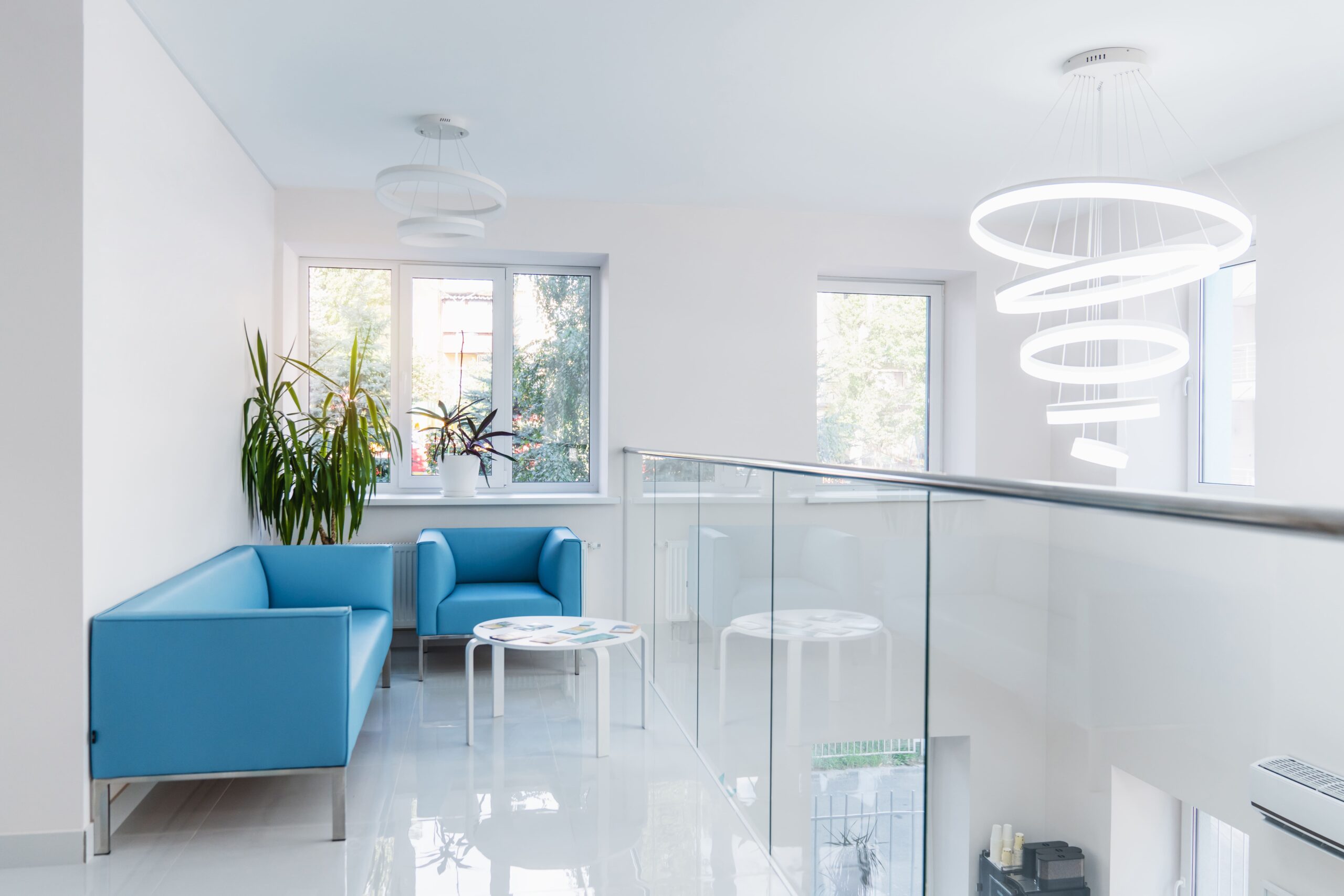
Has it ever crossed your mind how healthcare facilities’ lighting affects patient recovery and staff effectiveness? Honestly, the answer might surprise you. In reality, lighting transcends mere visibility.
Contemporary healthcare facilities are now aware that human-centric lighting can positively influence patient recovery and well-being. This change marks a basic shift in how general contractors, architects, and MEP experts embark on healthcare lighting design.
When designing healthcare spaces, the lighting specification directly affects circadian rhythms. These rhythms are important as they are our body’s 24-hour biological clocks that control sleep, healing, and mood.
Evidently, conventional static lighting systems cannot support such natural cycles. They leave patients and staff in poor lighting conditions. As a result, these conditions decelerate recovery and enhance fatigue.
So, having a detailed grasp of human-centric lighting and MEP unification is key to delivering competitive healthcare projects. The designs ought to favor patient well-being, along with safety and code adherence requirements.
What Really is Circadian Rhythm Support in Healthcare Lighting
Circadian rhythm support should be a priority for architects and general contractors when dealing with healthcare lighting. Also known as human-centric lighting, circadian lighting mirrors dynamic natural light patterns. This method assists in regulating our body’s internal clock using particular design techniques. Offering bright, blush light during the day maintains alertness and diagnostic precision. Evening lighting needs to be warmer and dimmer to encourage better sleep and natural melatonin production.
It should be kept in mind that healthcare settings come with unique challenges for lighting design. Patients normally spend prolonged durations indoors without being exposed to natural daylight. It is crucial to understand that when patients experience static lighting, their circadian rhythm turns out to be desynchronized. This contributes to inadequate sleep quality, increased agitation, and delayed recovery. Recent studies confirm that facilities that incorporate circadian lighting have reduced patient fall rates by almost half. This safety enhancement directly resonates with better sleep quality and alertness.
However, the practical application calls for an MEP team to coordinate lighting system design effectively. Daytime lighting must deliver a minimum of 275 equivalent melanopic lux between 7 o’clock in the morning and noon. Such specific light wavelengths most powerfully affect circadian responses. Evening lighting should maintain warmer color temperatures and lower illuminance. These adjustments enable natural melatonin production.
Essential Design Considerations
When designing healthcare lighting, the team must understand the technical parameters required for efficient circadian lighting, including:
- Daytime Color Temperature: During working hours, it is important to maintain a color temperature between 4000K and 5000K to support alertness and visual acuity. Staff can also pursue diagnostic tasks with greater accuracy.
- Evening Color Temperature: Make sure to transition to 2700K-3000K after sunset. Evidently, warm white lighting curtails circadian disruption, aiding natural sleep onset.
- Patient Room Illuminance: It is critical to provide 300 lux for observational tasks. While reading zones require 50-100 lux, nighttime capability should dim to 30 lux or lower.
- Operating Room Specifications: in the surgical areas, ensure maintaining 3000-10000 lux. A high color rendering index (CRI 90+) guarantees precise color visualization.
- Color Rendering Index: For patient care zones, a minimum CRI of 85-100 needs to be specified. Remember that examination and procedural areas need a CRI of 90 or higher. A higher CRI brings better color accuracy.
- Tunable LED Fixtures: Another important consideration is LED fixtures with tunable white capabilities spanning 2700K to 6500K. Dynamic adjustment takes place throughout the day, and staff can avoid changing fixtures.
- Control Systems: The implementation of DALI Type 8 color temperature control or building automation should be prioritized. It helps staff manually adjust lighting based on patient requirements. Programmed curves also assist in maintaining optimal defaults.
- Nighttime Lux Limiting: Ensure that evening and nighttime illuminance does not exceed 30 lux. This assures circadian rhythm support, reducing the risk of sleep disruption to a large extent.
Benefits and Optimal Initiatives for Healthcare Lighting Implementation
So, when human-centric lighting is incorporated into your MEP design, it delivers several benefits for patient care, including:
- Expedited Patient Recovery: Appropriate circadian lighting can considerably boost sleep quality. Patients also get to experience cognitive healing. Physical recovery also speeds up compared with static systems.
- Better Staff Alertness: The dynamic lighting system also benefits medical personnel working the night shift. Besides, during evening hours, a significant improvement in nighttime alertness can be observed. Bear in mind that circadian reset happens effectively during day shifts.
- Reduced Fall Risk: Healthcare facilities with circadian lighting represent notably lower fall rates. Additionally, better sleep quality directly leads to this safety enhancement. Better patient orientation also helps decrease incidents.
- Improvement in Sleep Quality: Blue-depleted evening lighting multiplies REM sleep duration by approximately 13.9 minutes nightly. Furthermore, melatonin suppression diminishes by around 30%, ultimately improving patients’ sleep quality.
- Energy Effectiveness: Installing tunable LED systems with occupancy control can reduce lighting energy consumption. Daylight harvesting also makes sure that energy usage is optimized.
Incorporating these optimal initiatives necessitates close coordination between lighting designers and the MEP team. Thus, during the SD phase, it is indispensable to establish circadian lighting as a major project requirement. Preference should be given to fixture types that support tunable white functionality. This mandates the creation of thorough lighting control narratives during design development.
GCs and architects should ensure that daily color temperature and lighting schedules are documented according to space type. Throughout the construction documentation stage, these should be coordinated with architectural and structural verticals. Eventually, this eliminates clashes among lighting fixtures, HVAC elements, and electrical routing.
MEP Integration and Sustainability Alignment
Keep in mind that your MEP design approach to healthcare lighting should deal with more than circuit design. Successful integration between mechanical, electrical, and control systems is pivotal to human-centric lighting. It results in responsive healthcare settings where electrical engineers specify tunable LED fixtures and dimming ballasts, control specialists design automated day-rhythm curves, and manual override capability guarantees clinical flexibility.
Sustainability is one such factor that reinforces the business case for investment. Modern-day tunable LED systems use far less energy than fluorescent technology. Better patient outcomes stem from these systems. When energy modeling is applied to circadian-responsive designs, it can ensure compliance with ASHRAE 90.1-2022. This is when designs surpass patient wellness expectations.
In addition to these, BIM coordination is critical to success. We know that lighting systems interact with mechanical systems and structural components. Here, 3D clash detection enables conflicts to be identified before construction work starts. As a result, conflicts among HVAC ductwork, lighting, and structural members emerge early. Also, instant coordination across electrical designers and MEP teams guarantees hassle-free integration. Finally, it is imperative that lighting control wiring integrates with low-voltage building automation systems.
Conformance to Healthcare Lighting Standards
At the time of specifying healthcare lighting, the latest industry standards that deal with circadian support should be referenced. The ANSI/IES RP-29-22 standard facilitates illuminance recommendations for each room type. This standard takes into account the significance of dynamic, circadian-responsive systems.
On the other hand, the design ought to fulfill ASHRAE 90.1-2022 energy-efficiency requirements. These specifications acknowledge that healthcare facilities necessitate 24/7 lighting. Moreover, IES standards detail distinct daytime and nighttime illuminance levels. The eyes of aging patients need 800 lux during the day and 400 lux during the night. Satisfying all these standards mandates deliberate MEP engineering coordination. Do not forget that simple prescriptive compliance is not enough, and supporting circadian rhythm needs an integrated design.
Final Notes
So, it’s understandable that human-centric lighting represents a core transformation in healthcare facility design. This approach effectively moves from thinking about lighting as just visibility. Rather, it is crucial to view lighting as an active therapeutic intervention.
From the perspective of GCs and architects, acknowledging the lighting-wellness connection explicitly influences competitive positioning. Ideal circadian lighting can substantially reduce falls and expedite recovery. Evidence also proves its positive effect on staff performance. Therefore, there should be some critical design considerations.
Implementing human-centric lighting requires top-drawer expertise across MEP verticals. This is the point where National MEP Engineers should be your one-and-only reliable partner. We are committed to delivering quantifiable value to your healthcare projects.
Be it designing new healthcare facilities or retrofitting, National MEP Engineers’ MEP engineering services offer the right set of technical solutions. Our specialty is intelligent MEP designs that match lighting to circadian principles. Through our sustainability design solutions, circadian-responsive lighting designs meet ASHRAE 90.1 standards.
So, partner with National MEP Engineers and gain access to experts with extensive understanding and experience in healthcare lighting.


